

Blog
Categories
Tags
Recent Posts
- All
- Health & Fitness
- Physiotherapy & Sports Massage


- June 23, 2026
- Author :lavanya nambiar
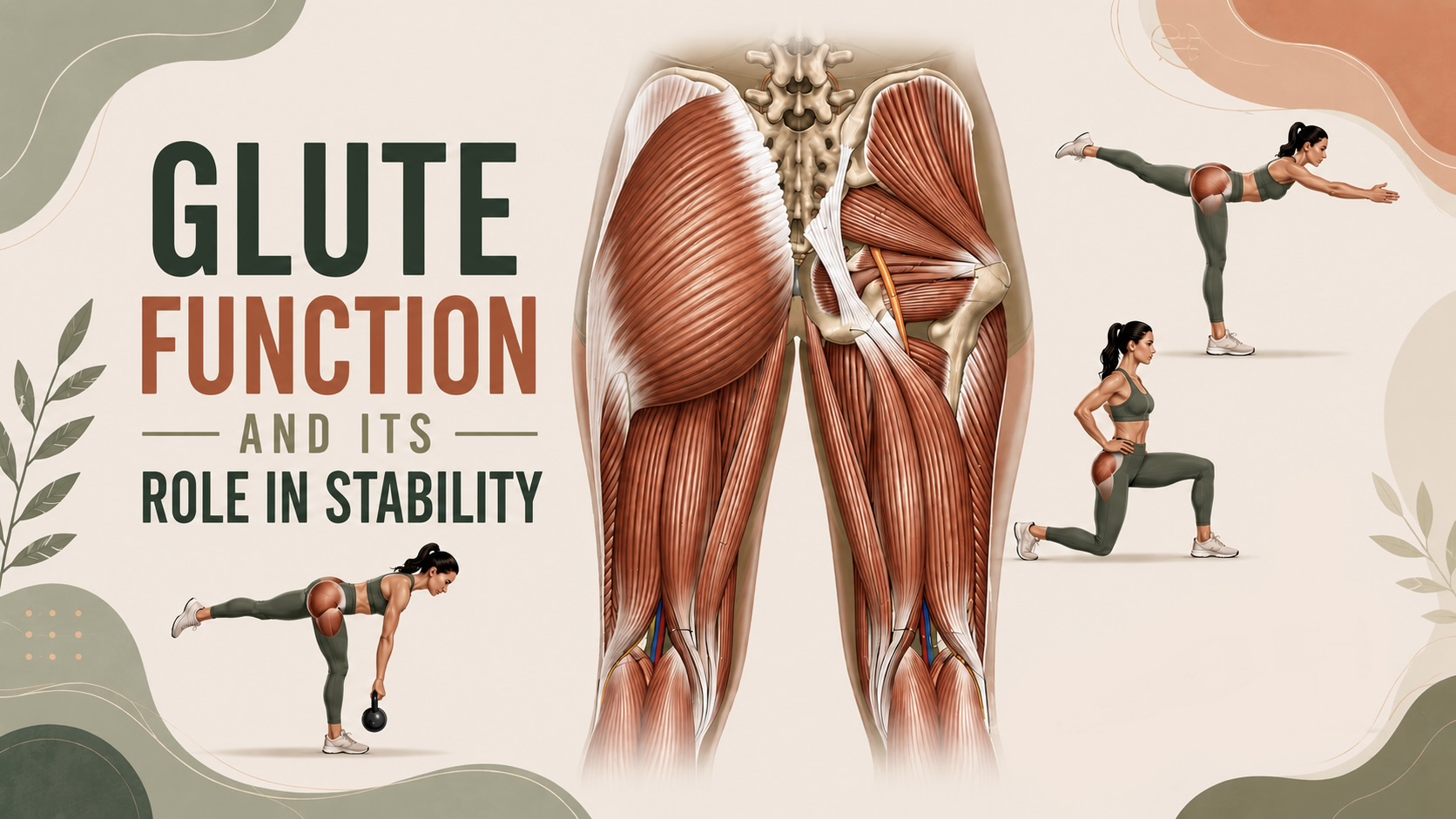
Glute Function and Its Role in Stability
Introduction
The glutes consist of three muscles—the gluteus maximus, medius, and minimus – which work together as an integrated system.
The glutes are often associated only with strength, aesthetics, and performance. But reducing them to “power muscles” misses their most important role – control.
Every step you take, your body relies on the glutes to stabilise the hip and manage how force moves through the system. Without this control, movement becomes inefficient, joints take on excess stress, and performance and long-term health begin to decline.
Understanding how the glutes function is key to training them effectively.
The Glutes: More Than Just Strength
The gluteus maximus is the primary force producer, responsible for hip extension and external rotation. Its role becomes increasingly important as load and speed increase, such as during sprinting, lifting, or rising from a seated position. It also controls motion, resisting excessive hip flexion and internal rotation under load.
The gluteus medius and minimus function as stabilisers and controllers of alignment. During walking, each step involves a moment of single-leg stance where these muscles prevent the pelvis from dropping and regulate femoral position. This ensures efficient load transfer through the pelvis and into the rest of the body.
Stability Is Not Rigidity
A common misconception is that stability means stiffness. In reality, stability is controlled motion.
From a biomechanical perspective, stability refers to the ability to maintain optimal joint alignment while allowing movement. The glutes contribute by dynamically centring the femoral head within the acetabulum, improving joint congruency and distributing forces efficiently across the hip and into surrounding joints.
What Happens When Control Is Lost
When the glute medius and minimus fail to perform this role effectively, predictable compensations emerge:
- Increased hip adduction and internal rotation
- Knee valgus (knee collapsing inward)
- Pelvic drop during walking or single-leg tasks
Over time, these patterns shift load away from active muscular control toward passive structures, increasing stress on the knee, lower back, and ankle. This is often where chronic pain and overuse injuries begin.
In older adults, the consequences are even more significant. Reduced glute strength and neuromuscular control impair balance and single-leg stability – key components of walking. This directly increases the risk of falls. In this context, glute function is critical not just for movement but for independence and safety.
Glute Function Is Task-Specific
Glute function adapts based on:
- Load
- Speed
- Direction
At approximately 90° of hip flexion, the line of pull of the gluteal muscles becomes more mechanically advantageous. The anterior fibres of the gluteus medius particularly gain significantly greater rotational leverage in this position.
Thus, exercise position and context matter more than simply “feeling” a muscle work.
Why Most Glute Training Falls Short
Many training approaches rely heavily on low-load, isolated exercises. While these may have value in early stages, they often fail to reflect real-world demands.
Exercises like clamshells, for example, involve short lever arms and minimal loading, limiting their ability to meaningfully challenge the gluteal system.
Train Movement, Not Just Muscles
To develop real glute function, prioritise unilateral, load-bearing exercises such as:
- Split squats
- Step-downs
- Single-leg deadlifts
These require the glutes to control the pelvis and femur under load exactly like in real life.
From there, training should progress to more dynamic tasks involving changes in speed, Direction & Reactive control.
Equally important is strengthening the surrounding system. The glutes work with the trunk, pelvis, knee, and ankle, forming a kinetic chain that enables efficient force transfer.
Practical Application: How to Train Glute Stability Effectively
If you want your training to carry over to real life and performance, focus on how the glutes function—not just if they are working.
1. Start with Control > Load
2. Prioritise Single-Leg Work
3. Progressive Overload
4. Train Across Positions
5. Add Speed and Complexity
6. Include trunk and lower limb training to support efficient force transfer.
Who Needs This Most?
This applies to almost everyone, especially athletes aiming to improve performance and reduce injury risk, desk-based individuals experiencing reduced glute activation, and older adults, where reduced hip stability significantly increases the risk of falls and loss of independence.
Conclusion
Strong glutes are important – but strength alone is not enough.
What truly matters is the ability of the glutes to control movement, stabilise the hip, and adapt to real-world demands. When trained correctly, they don’t just improve performance – they protect joints, enhance movement efficiency, and support long-term health.

We believe that exercise isn’t just about how it makes you look, but also how it makes you feel. Get fit today.
Contacts
B1&B2, Ground floor, Aswathi Apartments, No:4, 2nd Cres Park Rd, Gandhi Nagar, Adyar, Chennai, Tamil Nadu 600020
Whatsapp Number: 98419 11267
Every day: 6:00 am – 20:00 pm
Saturday: 6:00 am – 15:00 pm
Sunday: Closed
Read Our Blog
Never miss a moment of updates with this collection of our newest trends and tips in fitness industry.
Copyright © 2026 Futureselfperformanceinstitute